






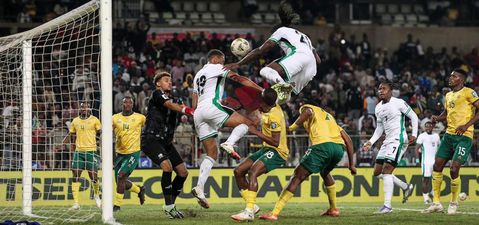
When the final whistle blew in Bloemfontein on September 9th, 2025, and the scoreboard read South Africa 1-1 Nigeria, a familiar mix of frustration and dread rippled through Nigerian football: the Super Eagles’ road to the 2026 World Cup had narrowed almost to a razor’s edge.
The draw left Nigeria trailing in Group C and sweating, according to observers, a result that crystallised fears the team’s campaign may yet end short of qualification for the tournament in North America.
However, some analysts mathematically still believe that Nigeria’s path to the 2026 FIFA World Cup is not yet over, but it’s decidedly precarious. That they still have a chance, but it’s hanging by a thread. In CAF Group C, Nigeria is third, tied on 11 points with Rwanda but behind Benin (14) and South Africa (17), who lead the group.
Only the group winner secures automatic qualification. The runner-up might enter a second-round playoff to reach the inter-confederation play-offs.
And that depends on the results of the remaining fixtures in the qualification series.
Nigeria must win both of their remaining games, away to Lesotho on October 6th, and against Benin at home in Uyo on October 13th, 2025, and hope for slips from South Africa or Benin. but realistically, Nigeria must aim to leapfrog at least Benin
CAF gets nine spots at the 2026 World Cup that will take place across three host nations – USA, Canada and Mexico, from June 11 to July 19, 2026. Two final slots will be filled through an inter-confederation play-off, from which Africa will also benefit.
Recent events have left the Super Eagles vulnerable, and all that has put that risk in the sweep of Nigeria’s World Cup history, and then tracing the scope of the socio-economic costs the country will face if it misses the 2026 finals.
The one-all draw with South Africa was not an isolated mishap. Nigeria’s campaign has been peppered with misfortune and missed opportunities: an own goal, the absence at crucial moments of talismanic forward Victor Osimhen through injury, and a group where only the winner is guaranteed an automatic CAF slot to the 2026 World Cup. Osimhen’s foot problem and subsequent absence from key fixtures was highlighted by international reports as a meaningful blow to Nigeria’s hopes.
Competition format for 2026 qualification (with a reduced number of guaranteed slots for African teams relative to the number of hopeful nations) has magnified the cost of any dropped points. Against that backdrop, a draw away to a direct rival felt less like a point gained and more like a missed lifeline.
To understand the present, we have to look at Nigeria’s World Cup story, a series of bright runs and stinging absences.
Breakthrough and early highs (1994–1998), Nigeria burst onto the global stage in 1994, reaching the round of 16 in their debut. They repeated a second-round appearance in 1998, cementing their reputation as one of Africa’s elite sides.
Nigeria’s inconsistency costs the country to miss the tournaments in 2006 and 2010. The 2000s and 2010s brought mixed results, group-stage exits in some tournaments and failure to qualify for others (notably missing the 2022 World Cup), highlighting problems with continuity and domestic development pathways.
The team has produced world-class talents and memorable moments but has struggled to translate intermittent individual brilliance into consistent tournament success.

Missing a World Cup is more than a headline for fans; it has measurable economic and social consequences. It includes lost tourism, sponsorship and broadcast attention. The World Cup is the planet’s largest sporting platform. Though the direct windfall for a non-hosting qualifying nation like Nigeria isn’t as huge as for host cities, qualification spikes media exposure, brings sponsorship renewals and increases merchandising and broadcasting revenue tied to national-team narratives.
Research on the 2026 tournament projects substantial global economic output from the event; individual nations that participate often reap heightened short-term commercial and brand benefits.
Also, there is opportunity cost for domestic football industries. Qualification creates momentum. federations, clubs and agencies often negotiate better deals, young players get scouted and transfer markets heat up. Missing out can depress transfer valuations for players who lose global showcase opportunities, and reduce negotiating leverage for agents and clubs.
The multiplier effects on small businesses and local economies is also a factor. In Nigeria, match-viewing culture drives spending in bars, eateries and informal venues. Qualification nights can be mini economic booms in city neighbourhoods. The absence of a World Cup run reduces those episodic revenue pulses and dampens entrepreneurial activity tied to football festivals.
There is equally the psychological and political capital. Football success has social cohesion value and political mileage. A strong World Cup performance can transiently lift national mood and, sometimes, be spun into soft-power wins abroad. Conversely, repeated failure can be exploited as shorthand for mismanagement across institutions, increasing pressure on football administrators and politicians.
That said, international studies also caution against overstating the long-term macro-economic benefits of mere qualification. Large-scale infrastructure windfalls are primarily a host-country phenomenon, and the sustained economic gains for a single qualifying nation depend on smart reinvestment of short-term windfalls rather than expectation alone.
And for the social costs, youth, aspiration and the football ecosystem, the GDP figures are subtler social costs. For many Nigerian youths, football is a ladder, a path out of poverty, a ticket to education and foreign contracts, and an engine for local academies that both employ coaches and keep kids engaged.
Missing a global stage reduces scouting exposure and dampens the dreams that keep grassroots programmes funded by hopeful parents and local sponsors.
Moreover, football is woven into Nigeria’s national identity in a way few industries are. Failure at major tournaments can depress morale in communities that invest time and scarce resources into local teams and talent development.
If the Super Eagles’ 2026 trajectory ends in failure, it will be the result of both short-term match-day events and chronic structural problems. Injuries to leading players (like Osimhen in 2025) underscore the need for better medical oversight, rotation policies and coordination with clubs.
Frequent changes of technical staff and inconsistent youth-to-senior transitions hinder cohesion. Governance lapses inside federations, unreliable funding for domestic leagues, and poor league structures reduce competitive minutes for Nigerian players. The failure of Nigeria in the recently concluded CHAN in Morocco readily comes to mind.
Addressing these requires a long game: stabilized coaching plans, investments in sports medicine and analytics, improved domestic league governance, and transparent, commercially-minded federation leadership.
Missing one World Cup is damaging but not terminal. The path back is visible: a recommitment to youth development, better ties between clubs and the national setup, sensible load management for top players, and professionalised administration. For Nigeria to translate footballing passion into consistent international success, the country needs to match its abundant talent with sustained institutional will.
In the short term, the Super Eagles’ draw in Bloemfontein on 9 September 2025 crystallised a crisis of confidence and illustrated how fragile qualification can be in a compressed CAF system.
In the long term, whether Nigeria misses 2026 or not, the debate that follows should not be about recrimination alone, but about pragmatic reforms that turn episodic brilliance into reliable performance, and transform football’s immense social capital into sustainable economic returns.